Motion Design Salaries in 2026: Your Complete Guide to What You Can Earn (and How to Earn More!)
How much can you earn as a Motion Designer in 2026? Find out what salaries look like, and what you can do to earn more.
:quality(82))
:quality(82))
:quality(82))
:quality(82))
:quality(82))
:quality(82))
:quality(82))
Last updated: February 2026 | Sources: BLS, Glassdoor, ZipRecruiter, PayScale, Robert Half, Levels.fyi, 6figr, Talent.com, Uxcel, ERI SalaryExpert, School of Motion, and more
Picture this: It’s 11 p.m., your latest client work just launched, and the client messages, “This is exactly what we needed!” You smile, close your laptop, and wonder:
How much is all this work actually putting in my pocket in 2026?
If that sounds familiar, you’re not alone. Motion design sits at the sweet spot of art, tech, and storytelling, powering everything from addictive social videos to buttery-smooth app interfaces. And in 2026, the pay reflects just how valuable those skills have become.
Whether you’re a fresh graduate building your first reel, a mid-level pro eyeing a raise, or a seasoned freelancer wondering if you’re charging enough, this guide has you covered. We’ve dug into the most recent February 2026 data from ZipRecruiter, Glassdoor, PayScale (updated Jan 2026), Robert Half, Kaplan, Levels.fyi, Talent.com, the BLS, Twine and more to give you a clear, realistic, and - yes - exciting picture of what’s possible.
Fair warning: In some cases, the data is genuinely all over the place. But by the end of this, you'll have a clear picture of what the market looks like right now, where the real money lives, and how to position yourself to earn more.
Let’s cut through the noise and discover exactly where your earning potential stands.
And more importantly, how to push it higher!
Note: This data heavily skews towards salary ranges in the US, with a section on the European market later in the article. Salary ranges outside of these areas may vary further.
Let's Talk About Why the Numbers Are All Over the Place
Here's something that trips up a lot of people when they Google "motion designer salary" for the first time: the numbers are wildly inconsistent depending on where you look. $65K here. $102K there. $144K somewhere else. What's going on?
A few things.
The U.S. Bureau of Labor Statistics — the most authoritative source we have — doesn't have a dedicated "motion designer" category. The closest federal classification is "Special Effects Artists and Animators" (SOC 27-1014), which lumps together motion graphics, VFX, 2D/3D animation, and game art.[^1] That broadness matters, because a Hollywood VFX supervisor and a junior motion graphic designer at a small agency are both in that bucket.
Private platforms like Glassdoor, ZipRecruiter, and PayScale each use completely different methodologies. Some rely on self-reported data (which skews toward people who feel like bragging about their salary), others use employer submissions, and sample sizes range from a few hundred profiles to tens of thousands. The job title itself is fluid — some companies post "motion graphics designer," others say "motion designer," "animator," or "visual designer (motion)." Same job, wildly different search results.
The honest answer? You need multiple data points to triangulate reality. And that's exactly what we've tried to do here.
The National Picture: What Motion Designers Are Actually Earning
Let's start with the aggregated view across the most credible sources, using 2025-2026 data.
Source | Role Title | Average / Median | Range / Notes | Data Date |
|---|---|---|---|---|
U.S. Bureau of Labor Statistics | Special Effects Artists & Animators | $99,800 median | 10th percentile ~$57K; | May 2024 |
Glassdoor | Motion Designer | $102,346 avg total pay | Includes bonuses; base ~$76.8K–$137.4K | Early 2026 |
Glassdoor | Motion Graphics Designer | $94,253 avg | Varies by submissions | Early 2026 |
Glassdoor | Senior Motion Designer | ~$135,000 avg | National senior-level aggregate | Early 2026 |
Glassdoor | Motion Designer (IT/Tech industry) | $149,000 median total pay | Tech pays VFX-level money for UI animations | Early 2026 |
ZipRecruiter | Motion Designer | $85,000 avg ($40.87/hr) | 25th: $64.5K; | Feb 2026 |
Talent.com | Motion Designer | $76,200 avg ($38.56/hr) | Entry: $62,875; | 2026, 10K+ salaries |
PayScale | Motion Graphic Designer | $70,852 base | Total pay $46K-$106K; | Jan 2026 |
Robert Half | Motion Designer | $76,250–$107,000 | Low/new: $76K; | 2026 |
6figr | Motion Designer (tech-focused) | $144,000 avg total | $118K-$269K range; | 2026 |
Levels.fyi | Motion (tech/product roles) | $139,000 avg total comp | Product design motion roles at tech companies | 2025–2026 |
Kaplan | Motion Designer | $92,779 avg | Top 10% earn $143,800+ | 2025–2026 |
Uxcel | Motion Designer | $65,000 avg | Range $35K–$120K; | Oct 2025 |
So what's the real number? Here's our honest take:
The realistic "good living" baseline for a competent full-time motion designer is $80,000-$110,000 in base salary. Once you factor in total compensation (bonuses, equity, overtime in VFX) you're easily looking at $120,000-$200,000+ for people in tech, entertainment, or senior-level roles.[^1][^2][^3]
The low end of that table (Uxcel's $65K average, PayScale's $70K) is real, but it's heavily weighted toward junior roles, smaller markets, and 2D-only generalists. The high end (6figr's $144K, Levels.fyi's $139K) is real too - but that's the tech world specifically, which operates by different rules.
What Your Experience Level Means for Your Paycheck
The salary progression in motion design is steeper than most creative fields. According to PayScale data, experienced professionals earn 69% or more above entry-level benchmarks.[^5] That’s a lot.
Entry-Level (0-2 Years): The Hustle and Build Phase
Fresh out of school, a bootcamp, or a self-taught path? You're looking at $35,000-$63,000 depending on where you are and what you can show.
PayScale puts early-career total compensation around $62,000[^5], Talent.com pegs entry at roughly $63,000[^4], and Uxcel's community data suggests a floor around $35,000 for the most junior positions.[^10]
Here's the uncomfortable truth about this tier: it's competitive, and credentials don't help you nearly as much as portfolio quality. The single most important thing you can do at this stage is build a reel that makes people stop scrolling. At School of Motion, we’ve been proven right over and over when we said portfolio quality is the strongest predictor of landing your first role and negotiating above-minimum offers.[^11]
Don't wait for “permission” to make great work. It’s not the certificate that says that your work is great, it’s your creativity.
Mid-Level (3-5+ Years): The Sweet Spot
This is where it gets genuinely interesting. You've shipped real client work, you've built some specialization, and you're not starting from zero on every new project.
Compensation at this stage clusters in the $70,000-$90,000 range. Robert Half puts the midpoint at roughly $89,500[^6], and if you've picked up 3D skills alongside your After Effects chops, you're pushing toward the higher end of that range - or even above it.
This is also the stage where your network starts to matter. The mograph community is small. People talk. Doing good work and being a good collaborator pays dividends that don't necessarily show up in salary questionnaire data.
Senior/Expert (6-10+ Years): Six Figures Is the Baseline
At this point, the question isn't whether you can make six figures - it's which path you take to maximize how far beyond six figures you go.
Senior motion designers and leads regularly command $100,000-$150,000+ in base salary. The BLS top 10% exceeds $170,000[^1], and Levels.fyi and 6figr both show tech-adjacent motion roles hitting $140,000+ in total compensation[^7][^8]. The community anecdotes support this - Reddit and mograph forums are full of stories about senior in-house tech motion leads earning $140,000 base with total compensation reaching $240,000 at companies like Meta, Google, and Apple.[^8]
If you've built multidisciplinary skills - 2D, 3D, sound design, client direction, niche expertise like Houdini or AR/VR - you're likely at the top of that range.
Creative Director/Studio Owner (10+ Years): The Ceiling Is Gone
At creative director or studio owner level, compensation stops following a formula. The BLS top 10% clears $170,000+ in base alone[^1], and once you layer in startup equity, VFX supervisor bonuses, or studio profit distribution, a total compensation of $250,000-$400,000 is documented.[^7]
This isn't guaranteed. Building to this level requires intentional moves, not just time served. But it is real, and it's worth keeping in the back of your mind as you think about what the long game looks like for you.
Where You Live Changes Everything (Unless You Go Remote)
Geography is one of the biggest levers in motion design compensation. Coastal tech and entertainment corridors consistently pay 30-50% above national averages — and that gap is wide enough to materially change your life.
Top-Paying US Metropolitan Areas
The BLS OEWS (Occupational Employment and Wage Statistics) breaks this down at the metro level for the "special effects artists and animators" category[^1]:
Metro Area | Mean Annual Salary |
|---|---|
Los Angeles–Long Beach–Anaheim, CA | ~$135,010 |
San Francisco–Oakland–Hayward, CA | ~$132,960 |
New York–Newark–Jersey City, NY-NJ-PA | ~$122,530 |
Seattle–Tacoma–Bellevue, WA | ~$117,500 |
The Remote Work Wildcard
Here's the thing that's changed everything in the last few years: remote work has blurred the geographic salary map in a massive way.
Many job listings now post $80,000-$150,000 regardless of where you live. Some companies still anchor comp to HQ cost of living, but that's becoming less common in creative and tech roles. Motion Recruitment's 2026 Tech Salary Guide found that remote tech workers saw 2.8% higher pay increases than in-office workers year-over-year, and that salary can still vary by over 24% between cities.[^13]
The strategic play - and plenty of motion designers are doing this - is to secure a remote role with Bay Area or NYC rates while living somewhere with a lower cost of living. That delta can be genuinely life-changing.
Freelance: The Upside Is Real, But So Is the Grind
Freelancing in motion design is extraordinarily common, and for good reason. The economics are fundamentally different from salaried life. The ceiling is theoretically uncapped.
But let's not romanticize it. Freelance also means managing your own taxes, insurance, equipment, downtime, and client acquisition. The feast-or-famine dynamic is real, especially in the first few years.
Here's what the data shows:
Freelance Salary Equivalents
Source | Metric | Amount |
|---|---|---|
ZipRecruiter | Freelance Motion Designer avg annual equivalent | $89,600 (~$43/hr) |
Glassdoor | Freelance Motion Designer | ~$96,000 |
School of Motion | Day rate starting point | $350-$500/day (scaling to $800+) |
Hourly and Day Rates by Experience Level
This is where the real money math lives. Community data that we’ve gathered at School of Motion, Twine, and mograph forums consistently reports these tiers[^11][^22]:
Experience Level | Hourly Rate | Day Rate |
|---|---|---|
Beginner (0-2 years) | $20-$40/hr | $350-$500/day |
Intermediate (2-5 years) | $40-$80/hr | $500-$750/day |
Senior/Advanced (5-8 years) | $80-$150/hr | $800-$1,000+/day |
Expert/Studio-Level (8+ years) | $150-$300+/hr | $1,000-$1,500+/day |
Niche Specialist (Houdini, AR/VR) | $200-$500+/hr | $1,500-$2,000+/day |
Project-Based Pricing
Many of the most successful freelancers stop thinking in hours and start thinking in value delivered. Project-based pricing is where you can really start to close the gap between what you make and what you're worth:
Project Type | Typical Range |
|---|---|
60-second explainer video | $1,000-$5,000 |
Logo animation | $200-$1,000 |
Product demo / UI animation | $1,500-$6,000 |
High-end commercial / broadcast | $30,000-$100,000+ |
The Freelance Math
At consistent utilization (150-200 billable days per year) a mid-to-senior freelance motion designer charging $500-$800/day can gross $75,000-$160,000 annually. At the higher end of consistent bookings, that number climbs to $120,000-$250,000+ gross.[^11][^22]
The catch: after accounting for taxes (~25-30%), insurance, software subscriptions, and unbillable time, your net take-home is typically 50-65% of gross. Still potentially excellent, but the math only works if you stay booked.
The difference between six-figure freelancers and people who struggle? Reliable pipelines. Agencies you have ongoing relationships with. Retainer clients. Direct relationships where clients come back to you by name. Building those takes years, but once you have them, the income gets a lot more predictable.
Start with $350-$500/day, do great work, ask for referrals, and scale.
Which Industries Pay the Most (Spoiler: Tech Wins)
Not all motion design work is compensated equally. The industry you're working in might matter as much as your experience level.
Industry Tier List
Tech / Product Design: This is the holy grail right now. Glassdoor reports a median total pay of $149,000 in the IT/tech category for motion designers[^2], and Levels.fyi shows an average of $139,000 for tech/product motion roles.[^8] Companies like Meta, Google, Amazon, Apple, and Roku are paying genuine product-designer money for people who can execute buttery 60fps micro-interactions. If you can bridge motion and product thinking, this is where the ceiling is highest.
VFX / Film: The BLS industry segment mean for motion picture and video production sits around $124,500[^1], driven heavily by LA concentration. Union work, overtime, and specialized rates often push VFX motion roles to $100+/hr. The tradeoff is crunch culture and boom-and-bust project cycles.
Media / Entertainment / Advertising: The next tier down, but still strong. NBCUniversal, AT&T, major ad agencies like Buck and We Are Royale pay $80,000-$135,000 for experienced talent.[^2] The work tends to be varied and portfolio-building.
Corporate / Marketing: Lower end of the spectrum ($70,000-$100,000 base) but often the most stable. Benefits are solid, hours are human, and the work keeps coming. Not glamorous, but genuinely sustainable.
Top-Paying Companies
If you're targeting specific employers, the data points consistently toward: Meta, Google, Amazon, Apple, Roku, Lucid Motors, Robinhood, Juniper Networks, and major streaming platforms.[^2][^8] At these companies, senior motion designers regularly clear $140,000-$200,000 in total compensation (base + equity/RSUs + bonuses).
The Skills That Will Earn You The Most Money in 2026
After Effects mastery is table stakes. If that's all you have, you're fighting for the middle of the market. Here's where the real premium skills live right now.
3D: Still the Biggest Multiplier
This one that the data keeps backing up. 3D proficiency is one of the single strongest salary multipliers in motion design, full stop.
ERI data shows 3D motion designers in Germany earning €66,903 versus €42,800-€48,000 for standard motion graphics roles - a premium of roughly 40-55%.[^16] London shows a similar pattern, with 3D specialists averaging £69,021, matching or exceeding senior non-3D roles.[^21]
Cinema 4D, Blender, and Houdini are the key tools. But here's what's getting hot right now: Unreal Engine for real-time 3D applications - virtual production, interactive installations, real-time brand experiences. Motion designers who can work in Unreal are occupying a genuinely underserved niche, particularly in entertainment and automotive.
If you haven't started learning 3D yet, I genuinely can't stress this enough: start now. It's not too late, and the payoff is real. School of Motion has several courses that can help you get started or advance existing skills.
Rive & Real-Time Interactive Animation
This one is less about where the salary data is today and more about where it's going tomorrow.
Rive has become one of the most talked-about tools in the motion design space, especially for UI/UX animation and interactive product experiences. Unlike After Effects (which outputs rendered video files), Rive produces lightweight, interactive animations that run natively in apps and web browsers.[^23] That means it slots directly into product development workflows, making it especially attractive to tech companies who want to treat motion as a core product discipline.
The motion designers who've figured out how to deliver Rive-based interactive work are positioning themselves for exactly the UI/UX motion roles at tech companies that command $120,000–$160,000+ in total comp.[^8] The tool bridges the gap between design and development in a way that After Effects simply can't, and that crossover skill is genuinely rare right now.
Other emerging tools worth watching: Cavalry for data-driven and procedural animation, Spline for 3D web experiences, and Lottie for web/app animation delivery. The through-line is interactive, code-adjacent, performance-conscious animation, which is exactly where tech product teams are willing to pay premium rates.
AI: The Double-Edged Sword
Let's not dance around this one, because it's the question everyone's asking.
Motion Recruitment's 2026 Tech Salary Guide - based on thousands of real placements - found that AI specialization roles increased 49% in demand year-over-year, while entry-level and generalist positions slowed.[^13] Tech salaries overall grew a modest 0.8%, but specialized roles saw the sharpest increases.
Here's the honest breakdown:
Routine 2D motion work is getting cheaper. AI tools like Runway, Kling, and generative animation platforms are genuinely compressing the lower end of the market. Simple explainer videos, basic logo animations, and template-driven social content that once sustained junior freelancers are getting undercut. This is real, and pretending otherwise doesn't help anyone.
But creative directors who integrate AI intelligently are commanding premiums. Designers who use AI as a force multiplier - generating concepts faster, automating tedious tasks, iterating on client feedback in real time - are positioning themselves for the 15–50% salary premiums that come with "AI-fluent" creative roles.[^13]
The strategic play isn't to fear AI or to ignore it. It's to learn how to direct it, prompt it, refine its output, and combine it with the craft skills and creative judgment that AI genuinely cannot replicate. That combination - human creative direction + AI efficiency - is what the market is starting to reward at the top end.
Other Skills Worth Stacking
Advanced After Effects expressions and scripting: Automating complex animations separates senior artists from mid-level ones. This is learnable and the payoff is immediate.
Sound design integration: Motion designers who deliver audio-visual packages instead of silent animations command significantly higher project rates. More deliverable, more value.
Storytelling and client communication: The ability to concept, pitch, and direct (not just execute) is what pushes compensation at every level. Being the person who understands the brief before the brief is written is invaluable.
Houdini simulations: Niche but extremely well-compensated. $200-$500+/hr for specialists is not an exaggeration.[^11]
The European Market: A Continent of Contrasts
If you're working in Europe or considering a move, the picture looks quite different from the US. There's massive variation driven by local cost of living, the maturity of the creative industry, and concentration of tech or agency work.
Pan-European Overview
A comprehensive 2025-2026 analysis by MotionVP (Vadim Popov), drawing on Glassdoor, PayScale, and local survey data, mapped average motion designer salaries across Europe[^14]:
Country | Average Annual Salary (EUR) | Notes |
|---|---|---|
Switzerland | ~€104,000 | Highest in Europe; Zurich/Geneva tech hubs |
Luxembourg | ~€84,000 | Small market, high compensation |
Denmark | ~€74,000 | Strong creative sector |
Norway | ~€63,000 | High cost of living to match |
Ireland | ~€62,000 | Dublin: Google, Meta, Apple EU HQs |
Finland | ~€59,000 | Growing gaming/tech animation sector |
Sweden | ~€50,000 | Stockholm creative scene |
Germany | ~€41,300 | Wide variance by city |
UK | ~€36,300 (~£30,000) | London commands a major premium |
France | ~€35,000 | Paris-centric market |
Spain | ~€27,000-€30,000 | Growing remote hub, lower COL |
Italy | ~€29,800 | Milan/Rome focused |
Poland | ~€20,000-€25,000 | Rapidly growing outsourcing market |
Romania | ~€20,000 | Strong tech talent, fast growth |
Bulgaria | ~€17,000 | Lowest in EU survey |
United Kingdom Deep Dive
The UK market is heavily London-centric, with a substantial gap between the capital and everywhere else:
Source | Role / Location | Average | Range |
|---|---|---|---|
PayScale | Motion Graphics Designer (UK) | £29,552 | £23K-£46K |
Glassdoor | Motion Graphics Designer (UK) | £34,538 | £28,143-£43,196 |
Glassdoor | Motion Designer (UK) | £35,256 | £28,245-£44,732 |
IT Jobs Watch | Motion Designer (job postings) | £45,000 median | Advertised salaries |
ERI | Motion Designer (London) | £69,070 | £47,313-£84,344 |
ERI | 3D Motion Designer (London) | £69,021 | Specialist premium |
PayScale | Entry-level (UK) | £21,685 | Starting salaries |
That gap between ERI's London-specific data (£69K) and national averages (£29K-£35K) tells you everything you need to know about how concentrated high-paying motion design work is in the capital. Manchester, Bristol, and Edinburgh are emerging as secondary hubs, but they still lag significantly.
Germany Deep Dive
Germany is Europe's largest creative market, with meaningful internal variation between cities. Berlin, Munich, and Hamburg lead on compensation. 3D-specialized roles earn a notable premium over standard 2D motion graphics positions, same as the dynamic in the US market.
Other Global Markets
Australia: Sydney and Melbourne motion designers typically earn AUD $70,000-$100,000 (roughly USD $45,000-$65,000), with senior roles at agencies and tech companies pushing above AUD $120,000.
Canada: Toronto and Vancouver are the primary hubs, with salaries ranging from CAD $55,000-$90,000 (USD $40,000-$65,000). Senior VFX and film roles push to $90,000-$130,000 CAD.
India & Southeast Asia: Rapidly growing markets with significantly lower base salaries ($8,000-$25,000 USD equivalent for junior/mid roles), but increasingly competitive for remote freelance work serving Western clients at Western rates.
Big Trends in 2026
Market Polarization Intensifies
The most significant shift in 2026 isn't growth or decline, it's polarization. The middle of the market is getting squeezed.
Entry-level, commoditized motion work faces pricing pressure from AI tools and global competition. Meanwhile, the premium end - complex storytelling, high-craft 3D, interactive experiences, AI-directed creative - is seeing genuine talent shortages and salary inflation.
The gap between the 10th percentile ($32K-$57K) and the 90th percentile ($126K-$170K+) is wider than almost any other creative profession.[^1][^3] That's not a bug in the system. That's a signal about where to invest your skills.
Job Growth: Steady, Not Explosive
The BLS projects 2% growth for the broader "special effects artists and animators" category through 2034. That’s slower than average for the economy, but with approximately 5,000 annual openings, it’s mostly driven by turnover rather than net new positions.[^1]
That headline number understates the real demand for motion design specifically, which is being fueled by the explosion of digital video content across social media, streaming, advertising, and product interfaces. The content demand is huge. The polarization toward specialized work is real. Generalists who stay generalists will feel the squeeze; specialists who invest will feel the tailwind.
What's Driving Demand
Short-form video: TikTok, Reels, YouTube Shorts. Brands need content at unprecedented volume.
Streaming platform competition: Title sequences, promotional motion, in-app animations for Netflix, Disney+, Apple TV+, and the rest.
Product/UX animation: Tech companies are increasingly treating motion as a core product discipline, not an afterthought.
AI-generated content post-production: AI creates raw material; skilled motion designers refine, direct, and polish it.
Immersive/AR/VR: Early but growing. Real-time motion for spatial computing is a genuine emerging frontier.
Remote Work: Still Here, Still Powerful
Despite return-to-office pressure across some industries, remote work in tech remains popular and growing. Motion Recruitment's data shows 35% of tech employees cite remote/hybrid flexibility as a top factor in considering job changes, tied with higher compensation (43%) as the second most common reason.[^13]
For motion designers, who can virtually perform their entire job on a laptop with cloud-based collaboration tools, this matters enormously. The geographic arbitrage opportunity remains one of the most powerful financial strategies in the profession.
The AI Factor: How Artificial Intelligence Is Shaping Salaries in 2026
AI tools (Runway, Kling, Adobe Firefly, etc.) are changing the game — automating routine keyframing and asset generation. Entry- and mid-level commodity work faces some pressure, but here’s the exciting truth: AI-fluent motion designers who direct, refine, and add human storytelling are commanding 15–30% premiums.
Professionals who treat AI as a superpower (prompt engineering + traditional craft) deliver faster, tackle bigger projects, and focus on high-value creative direction. The field is polarizing: basic tasks get commoditized, while strategic, premium work sees even stronger demand.
BLS projects modest 2% growth for the broader animator category through 2034, but steady openings from turnover and expanding niches (AR/VR, data viz, real-time motion) keep opportunities flowing.
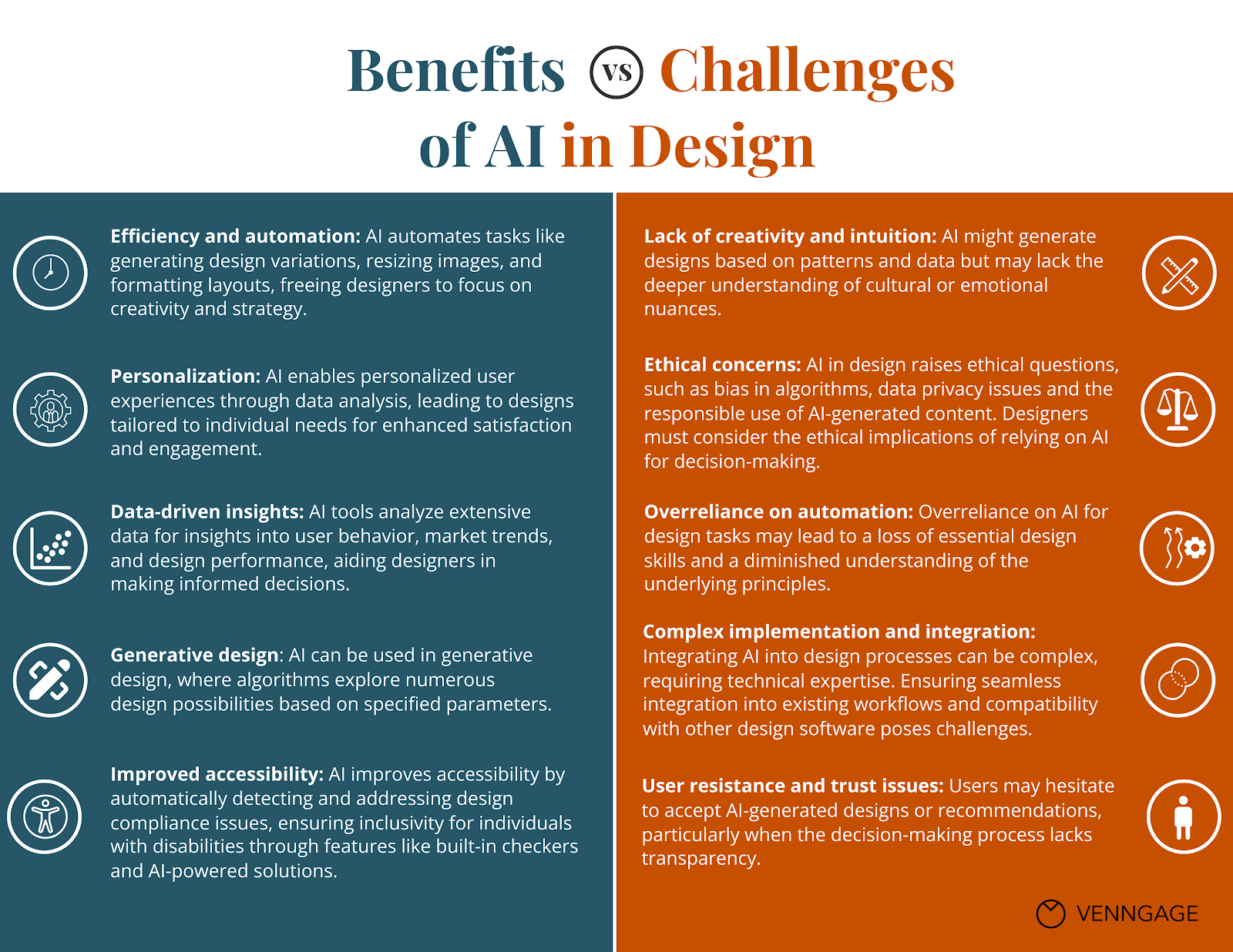
How AI Can Actually Help Designers, Not Harm Them - Venngage
In Summary: How to Actually Get Paid More
You've seen the data. Here's what it tells us about the moves that actually work.
Build a killer reel, not just a resume
Every hiring manager, recruiter, and salary survey confirms this: demonstrated portfolio quality predicts compensation more reliably than years of experience, degrees, or certifications.[^11] A two-year designer with a stunning reel will likely out-earn a five-year designer with a mediocre one.
Specialize in high-premium skills
Cinema 4D, Houdini, advanced expressions in After Effects, Rive/interactive animation, 3D + real-time rendering, AI-integrated workflows. These are the skill investments most likely to push your compensation above the median. After Effects mastery is the floor, not the ceiling.
Know your numbers and negotiate from data
This guide gives you the ammunition. A mid-level motion designer earning $70K who discovers that Glassdoor and ZipRecruiter support $85K-$95K for their experience level and location has a concrete, specific negotiating position. Use it.
Think carefully about the freelance path
Full-time employment gives you stability and benefits. Freelancing - or eventually building a studio - unlocks uncapped earning potential. Many of the highest earners in motion design are independent, building direct client relationships and scaling through subcontracting. It's not for everyone, but it's worth understanding the math.
Network relentlessly
The mograph community is remarkably open and interconnected. Motionographer, School of Motion's community, Behance, LinkedIn, conferences, local mograph meetups - this is where relationships happen, and relationships lead to referrals, which lead to better work at better rates. Your network is a compounding asset.
Target high-paying industries and geographies
If maximizing income is a priority, tech product design, VFX/film, and major metro areas (or remote roles pegged to their salaries) offer the clearest paths to six-figure compensation. Know where the money is and make intentional moves toward it.
One last thing: this field rewards people who take it seriously. The range between the bottom and the top of this profession is genuinely extraordinary, from $35K junior roles to $400K+ creative director packages. Most of that range is determined not by luck but by the intentional accumulation of skills, portfolio quality, relationships, and strategic career decisions.
You're already doing the right thing by looking at the data. Now go make something great, and get paid your worth!
Footnotes & Sources
[^1]: U.S. Bureau of Labor Statistics. "Special Effects Artists and Animators." Occupational Outlook Handbook, May 2024 data. https://www.bls.gov/ooh/arts-and-design/multimedia-artists-and-animators.htm. Metro/state data from OEWS: https://www.bls.gov/oes/current/oes271014.htm
[^2]: Glassdoor. "Motion Designer Salaries" and "Motion Graphics Designer Salaries." 2026 aggregates. https://www.glassdoor.com/Salaries/motion-designer-salary-SRCH_KO0,15.htm
[^3]: ZipRecruiter. "Motion Designer Salary." February 2026. https://www.ziprecruiter.com/Salaries/Motion-Designer-Salary
[^4]: Talent.com. "Motion Designer Salary in United States of America." 2026, 10,000+ salaries. https://www.talent.com/salary?job=motion+designer
[^5]: PayScale. "Motion Graphic Designer Salary." Updated January 19, 2026 (659 profiles). https://www.payscale.com/research/US/Job=Motion_Graphic_Designer/Salary
[^6]: Robert Half. "Motion Designer Salary Guide." Updated 2026. https://www.roberthalf.com/us/en/job-details/motion-designer
[^7]: 6figr. Motion Designer compensation profiles (38 profiles, tech-focused). 2026. https://6figr.com
[^8]: Levels.fyi. Tech/product-design motion role compensation data. 2025–2026. https://www.levels.fyi
[^9]: Kaplan salary aggregation. Motion Designer data, 2025–2026.
[^10]: Uxcel. "Motion Designer in the USA: Salary, Skills, and Career Insights." October 28, 2025, 300K+ designer community. https://uxcel.com/blog/motion-designer-in-the-usa
[^11]: School of Motion. "How Much Does the Average Motion Designer Make?" and "How Much to Charge for Your Motion Graphic Projects." https://www.schoolofmotion.com/blog/motion-graphics-salary and https://www.schoolofmotion.com/blog/charge-motion-graphics-rate
[^12]: Salary.com. "Motion Graphics Designer Salary." 2025–2026. https://www.salary.com/research/salary/listing/motion-graphics-designer-salary
[^13]: Motion Recruitment. "2026 Tech Salary Guide." Released December 2025. https://motionrecruitment.com/tech-salary-guide. See also: https://seekingalpha.com/pr/20346885-motion-recruitment-releases-2026-tech-salary-guide
[^14]: MotionVP (Vadim Popov). European motion designer salary analysis, 2025–2026. https://www.motionvp.com
[^15]: Glassdoor Germany. Motion Designer and Motion Graphics Designer salary pages. Early 2026. https://www.glassdoor.de/Gehälter/motion-designer-gehalt-SRCH_KO0,15.htm
[^16]: ERI SalaryExpert. Motion Designer and 3D Motion Designer salary data, Germany. 2026. https://www.erieri.com/salary
[^17]: PayScale Germany. Motion Graphic Designer salary by experience level. 2025–2026. https://www.payscale.com/research/DE/Job=Motion_Graphic_Designer/Salary
[^18]: PayScale UK. Motion Graphics Designer salary. 2025–2026. https://www.payscale.com/research/UK/Job=Motion_Graphics_Designer/Salary
[^19]: Glassdoor UK. Motion Designer and Motion Graphics Designer salary pages. Early 2026. https://www.glassdoor.co.uk/Salaries/motion-designer-salary-SRCH_KO0,15.htm
[^20]: IT Jobs Watch. Motion Designer salary data based on UK job postings. 2025–2026. https://www.itjobswatch.co.uk
[^21]: ERI SalaryExpert. Motion Designer and 3D Motion Designer salary data, London, UK. 2026. https://www.erieri.com/salary
[^22]: Twine. "How Much Does It Cost to Hire a Motion Graphic Designer?" October 28, 2025. https://www.twine.net/blog/cost-to-hire-a-motion-graphic-designer/
[^23]: TodayMade. Analysis of motion design tools and workflows, including Rive, Cavalry, and emerging platforms. 2025–2026. https://todaymade.com
[^24]: Noble Desktop. "Motion Graphics Designer Salary Information." https://www.nobledesktop.com/careers/motion-graphics-designer/salary
This guide was compiled in February 2026 using the most current data available from government sources, private salary platforms, industry surveys, recruiter reports, and community data. Salary figures represent approximations based on reported data and should be used as directional guidance. Individual compensation depends on portfolio quality, negotiation, specific role scope, company size, and local market conditions. All figures are in USD unless otherwise noted.
All-Access
Keep building taste with guided motion design training.
Get 50+ courses, project-based lessons, critique, and a community built for artists who want their work to feel sharper.
Explore membership:quality(82))
Unpacking the State of Motion Design in 2025
Join Joey and the gang as we look back at the last year of the motion design industry and try to figure out what the next 365 days and beyond will look like.
:quality(82))
After Effects' AI Agent is HERE & Rive Can't Stop Won't Stop | Motion Mondays
After Effects can now take spoken instructions and build an editable rig, Rive shipped another pile of serious animation tools, and Dash Bash is bringing five hundred motion designers back to Raleigh.
:quality(82))
New AE Particle Plugin + Blender 5.3 Teases New NPR Shading | Motion Mondays
There's a fast new GPU-based particle plugin for After Effects in beta, an AI agent lives inside After Effects and actually impressed Jake Bartlett, and Blender is getting real per-light cel shading in 5.3.